Scaling a multi-location digital experience.
Type
Website
Brand
Role
Senior Product Designer
Team
Product Designer(3)
Web Developer(2)
Project Manager(1)
Skills
Research
Produt Design
Usability testing
Overview
Business outgrowing it's outdated website.
With a expanding number of climbing gym locations, Hive Climbing was outgrowing it's website. I worked as a senior product designer within a cross-functional team of two other product designers and two developers, shaping key decisions across architecture, experience strategy, and execution.
Problem
Navigation created uncertainty instead of clarity.
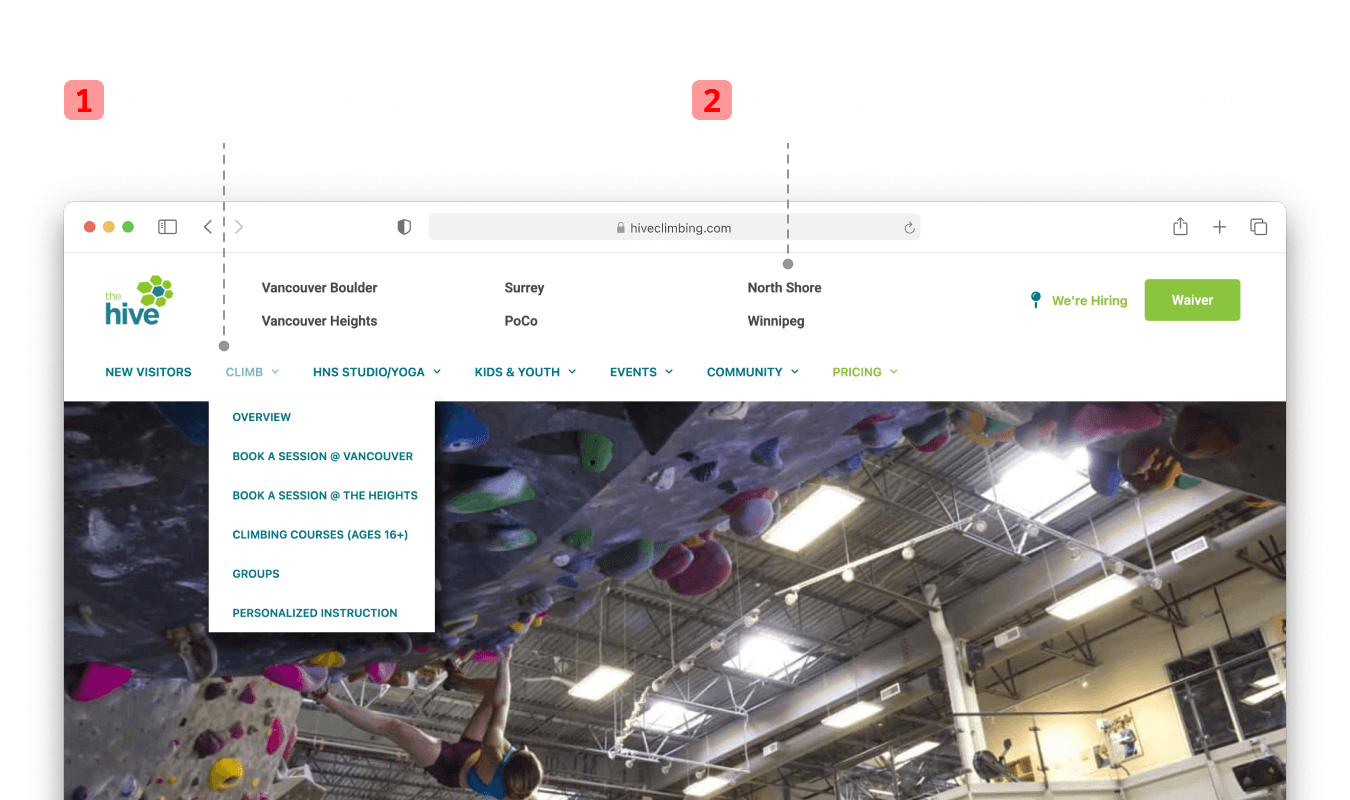
As the site expanded, navigation became layered and fragmented. Users often couldn’t tell whether the information they were viewing applied to one location or all gyms, which led to hesitation and repeated backtracking when trying to find programs, pricing, or hours.
The homepage didn’t help users orient or take action.
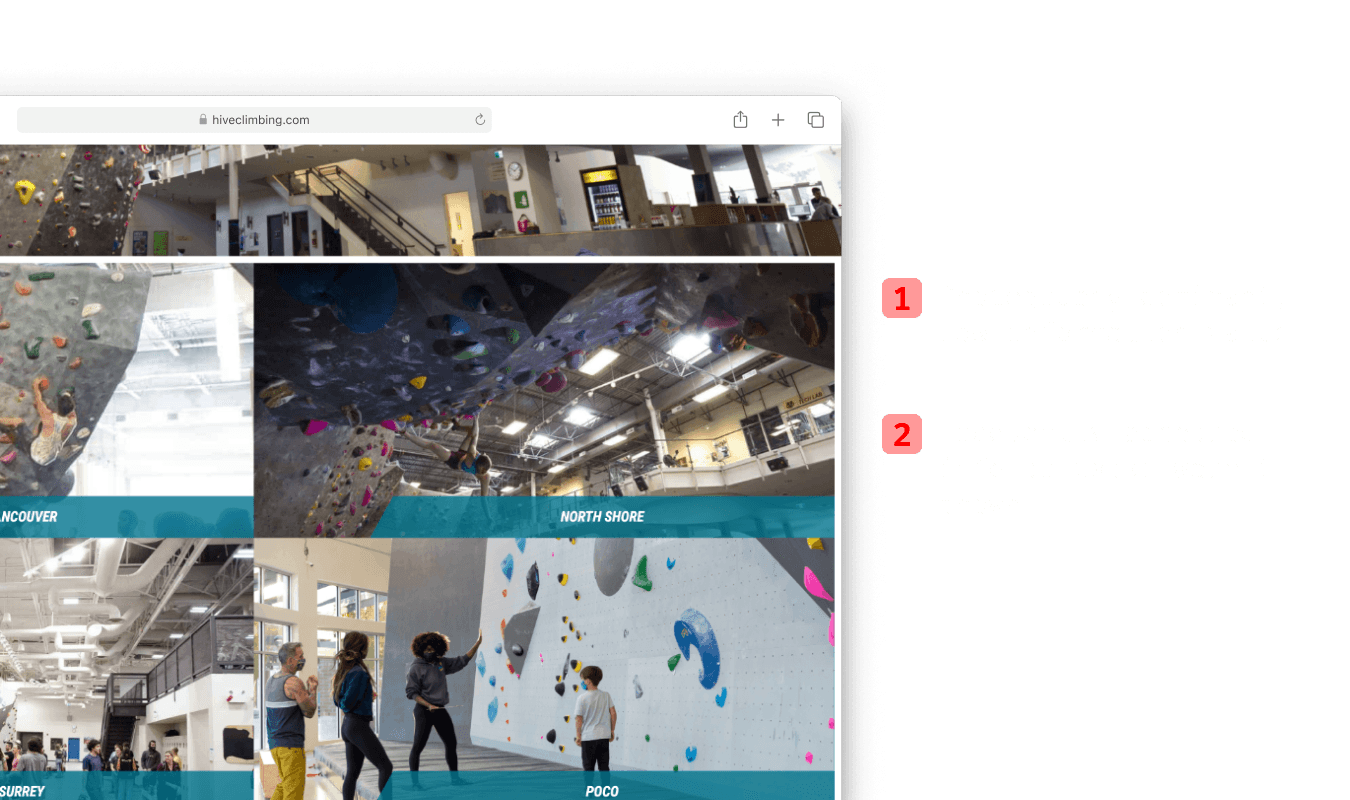
The homepage focused heavily on visual repetition but offered little practical guidance. It didn’t surface live, location-specific details like hours, closures, or upcoming events, so users still had to search deeper to complete common tasks.
Pricing required effort to understand.
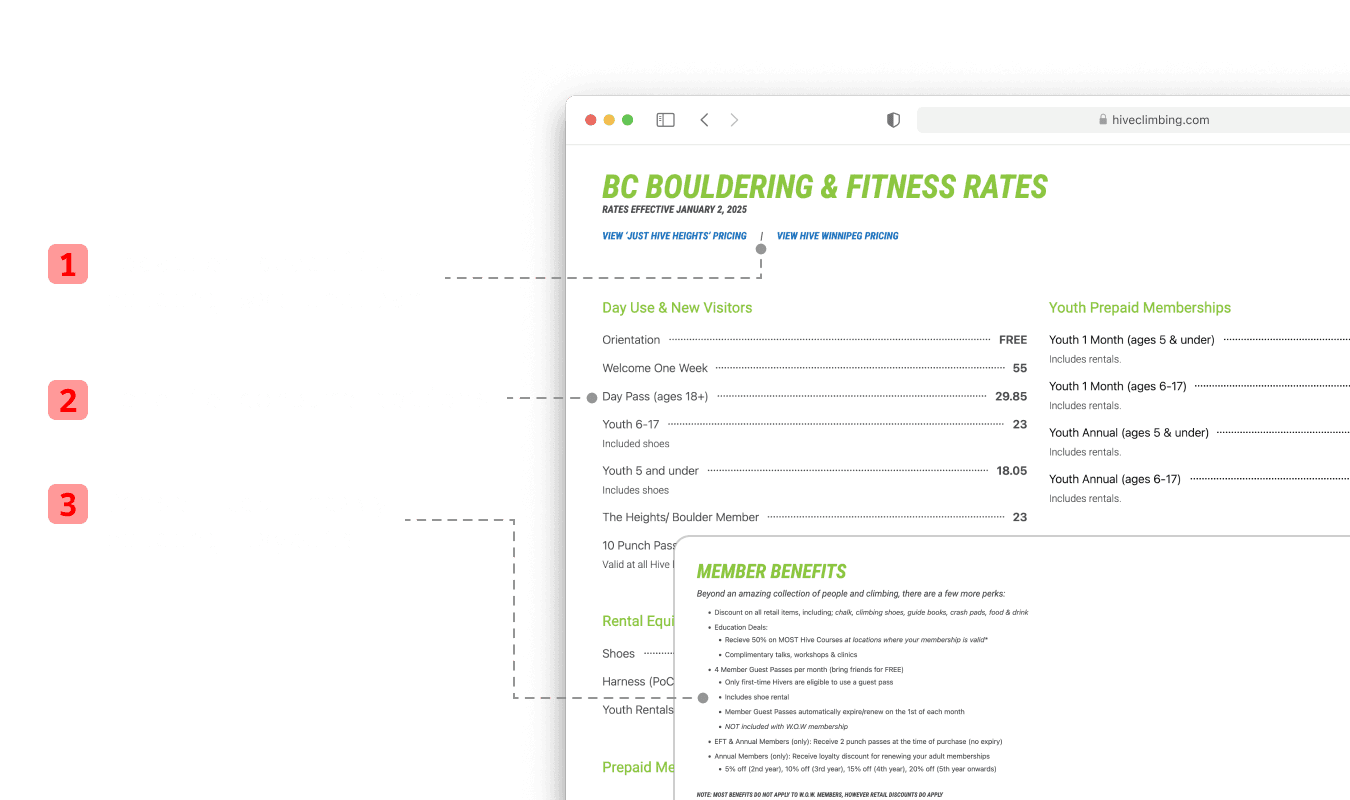
Pricing and membership information was dense and difficult to compare. Differences between passes, memberships, and locations were buried in long sections of text, making it hard for users to understand what applied to them without careful reading or staff help.
Decisions
Shift from page-based design to a location-aware system.
We aligned on a system-first strategy that prioritized clarity, consistency, and real-time relevance—designing shared structures that adapt by location to allow for easy maintenance and straight forward experience for the end-user.
Designing with modularity in mind.
We designed and developed components with modularity and resusability in mind to allow for Hive Climbing for future scalability with as much ease and guidance as possible.
Solution
A new website with straight-forward navigation and location-switching.
Navigation and core flows were restructured so users always knew which gym they were viewing, reducing ambiguity across programs, schedules, and pricing.
Simplified everyday pricing and membership discovery
Pricing and membership information was reorganised to support comparison and understanding, helping users make decisions without staff intervention.
Homepage as a point of orientation
The homepage was redesigned to surface time-sensitive, location-specific information—hours, events, alerts—so users could orient and act immediately.
Results & REFLECTION
The website now scales with the business instead of holding it back.
Post-launch testing showed clearer navigation, stronger location awareness, and improved confidence in pricing and program discovery, while staff relied less on manual explanations. The project reinforced that the biggest gains came from aligning systems, content, and operations—not visual polish alone.